

 All articles
01 The question
The price per user is not the cost of the project.
When HR and IT teams compare employee experience platforms, the first number they see is usually a monthly price per user. It is easy to read and easy to approve. But the real question for a finance committee is different: how much will this platform cost us over the next five years, for the whole workforce, including the teams we plan to hire? Answering it means looking at the full cost of ownership, not the entry price.
02 Two models
Paying for access versus owning the right to use.
With per-seat SaaS, you rent access: the vendor hosts and updates the software, and you pay a subscription for every active user, every month, for as long as you use it. With a perpetual license, you buy the right to use the software once, usually with an annual maintenance and support contract, and you choose where it runs: on your own servers, in a sovereign cloud or in your private cloud. Neither model is better in absolute terms. They simply spread costs differently over time.
03 The key variable
Headcount is what tips the balance.
The per-seat model scales with your workforce. That is fair for a small team with a stable size. It becomes expensive when you want to include everyone: operators, drivers, agents, store staff, seasonal workers. These are precisely the people an inclusive employee app is meant to reach, and they are often the largest share of the headcount. Every hire, every new site and every seasonal peak adds to the bill.
x3headcount in the example below, with no change to the license cost
Perpetual license vs SaaS at a glance
| Criterion | Per-seat SaaS | Perpetual license |
|---|---|---|
| How you pay | Monthly or annual subscription, for every user | Bought once, then annual maintenance |
| When headcount grows | Cost rises with every user added | Often no effect on the license; with WE, no per-user cost |
| Getting started | Fast, no upfront investment | Investment in year one, rollout to plan |
| Data hosting | With the vendor | On-premise, sovereign cloud or private cloud, your choice |
| Updates | Included, on the vendor's schedule | Through the maintenance contract, at your pace |
| If you stop paying | Access stops | The right to use remains yours |
| 5-year cost with a growing workforce | Highest in the example below | Lowest from year 3 in the example below |
A simple method to compare both models
You can run this comparison in a spreadsheet in less than an hour. For each of the next five years, list:
- Headcount covered: not only today’s users, but the employees you actually want to reach, including frontline and seasonal teams, and your hiring plan.
- SaaS cost: price per user per month × users × 12, plus paid modules, premium support and the annual price increase written in the contract.
- License cost: the license itself (usually paid in year 1), deployment and integration, annual maintenance and support, and hosting (your servers or your cloud).
- Internal cost: the time your IT team will spend operating the platform if you host it yourselves. It is lower than people fear, but it is not zero.
Then add up each column year after year and look at when the curves cross.
An illustrative example
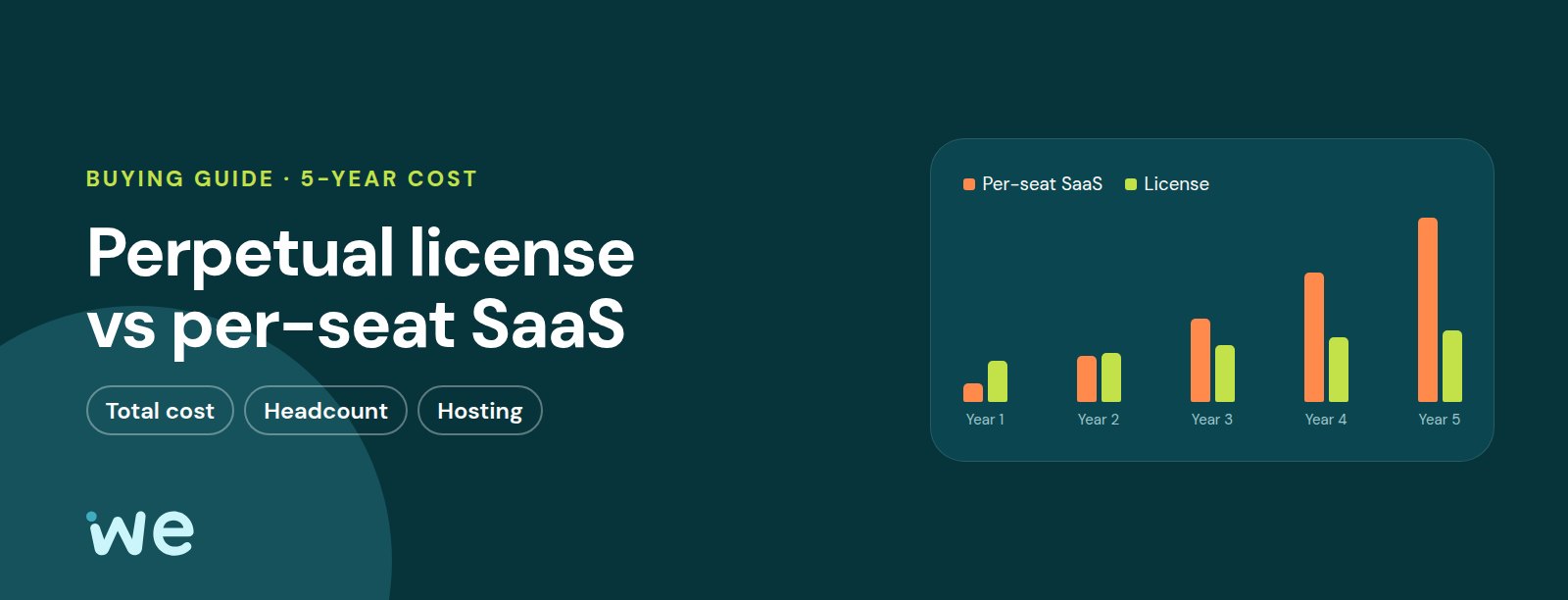
The figures below are hypothetical, in thousands of any currency. They are not a WE quote; they only show how the two curves behave. Assumptions: a workforce growing from 1,000 to 3,000 employees over five years, SaaS at 3 per user per month, and a perpetual license with deployment in year 1 followed by maintenance and hosting at a flat annual cost.
| Year | Employees | SaaS, cumulative | License, cumulative |
|---|---|---|---|
| Year 1 | 1,000 | 36 | 80 |
| Year 2 | 1,500 | 90 | 95 |
| Year 3 | 2,000 | 162 | 110 |
| Year 4 | 2,500 | 252 | 125 |
| Year 5 | 3,000 | 360 | 140 |
In this scenario, SaaS is clearly cheaper in year 1, the two models are close to break-even in year 2, and the license becomes cheaper from year 3. After five years, SaaS has cost about two and a half times as much as the license, and the gap keeps widening with every hire.
When SaaS remains the right choice
To be fair, per-seat SaaS is often the better option when:
- your headcount is small and stable, and will stay that way;
- you need to start in days, with no budget for an upfront investment;
- you have no IT team or cloud partner to run the platform, and no data residency constraint;
- the project is a short-term pilot rather than a long-term foundation.
When a perpetual license makes more sense
A license usually wins when:
- you want to include every employee, not only those with a corporate email;
- your workforce is large, growing, multi-site or seasonal;
- you need to control where employee data is hosted, for regulatory or sovereignty reasons;
- you think in terms of a five-year program, and prefer an investment you own to a subscription that grows every year.
Questions to ask every vendor
- What is the total cost over five years for our real headcount, including future hires?
- What price increase does the contract allow each year?
- Which modules, integrations and levels of support are included, and which are extra?
- Where is our data hosted, and can we change that later?
- What happens to our data and our access if we stop paying?
Frequently asked questions
Is a perpetual license really cheaper than SaaS?
Not always. SaaS is often cheaper in the first year. A license usually becomes more cost-effective when the workforce is large or growing and the project is planned over several years.
What does the cost of a perpetual license include?
The license itself, rollout and integrations, annual maintenance and support, hosting, and your IT team’s time if you host the platform yourself.
Do you need an IT team for a perpetual license?
Someone has to run the platform: your IT team, a partner or a private cloud provider. The time required is usually lower than expected, but it belongs in the calculation.
What happens to the data if you stop a SaaS subscription?
It depends on the contract: access stops and data retrieval has to be planned. With a perpetual license hosted on your side, the data stays on your infrastructure.
How do I compare both models for my company?
Over five years, with your real headcount and hiring plan, adding up every cost year by year. The method in this article takes less than an hour in a spreadsheet.
How WE approaches it
WE is sold as a perpetual license, independent of your headcount: your next thousand employees add nothing to the license. It runs on-premise, in a sovereign cloud or in your private cloud, and can be rolled out step by step, starting with a pilot site. We are happy to build this five-year comparison with your own figures.
The license model is only one of the criteria: see the 8 criteria for choosing an inclusive employee experience platform.
